There ought to be something like Iron Chef for programming. Naturally, the Iron Coders would each represent a different paradigm: functional, imperative, object oriented, declarative. Actually, I have no idea how this would work and suspect it probably would not very entertaining at all. I just like the idea of summoning IRON CODER FUNCTIONAL! The guy rises with a platform and it's got a little lambda on it...
2007-05-06

2007-05-01
haskell wikibook now featured
Spot the lambda?
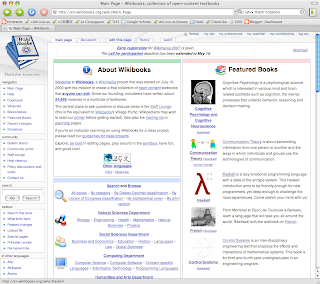
Haskell :: Functional Programming with Types is now a featured wikibook, which means that it will be rotated on to the front page on a regular basis.
There are around 40 books on the site that have this distinction, so if you don't see the Haskell book on the front page, try again in another hour or so.
Note that the wikibook version of Write Yourself a Scheme in 48 Hours has also been featured for quite some time. Yay, Johnathan! It's not on the front page yet, but should be making its way into the rotation at some point. Its blurb is
as follows:
Haskell :: Functional Programming with Types

Haskell :: Functional Programming with Types is now a featured wikibook, which means that it will be rotated on to the front page on a regular basis.
There are around 40 books on the site that have this distinction, so if you don't see the Haskell book on the front page, try again in another hour or so.
Write Yourself a Scheme in 48 Hours
Note that the wikibook version of Write Yourself a Scheme in 48 Hours has also been featured for quite some time. Yay, Johnathan! It's not on the front page yet, but should be making its way into the rotation at some point. Its blurb is
as follows:
 | In this advanced Haskell tutorial, we will implement a significant subset of Scheme together. We assume no prior knowledge; however, we will be going fast. So if you're feeling ambitious, why don't you Write Yourself a Scheme in 48 Hours? |
2007-04-24
le gentle introduction
Je viens de voir sur Haskellwiki que la traduction du Gentle Introduction to Haskell est terminée. Félicitations et merci à Nicolas Vallée et TuTuX.
I just noticed that the French translation of A Gentle Introduction to Haskell has been complete. Thanks and congrats to the authors. Now how about a YAHT translation or a wikilivre on Haskell?
I just noticed that the French translation of A Gentle Introduction to Haskell has been complete. Thanks and congrats to the authors. Now how about a YAHT translation or a wikilivre on Haskell?
2007-04-20
Haskell wikibook blurb
The wikibooks project has a 'featured book' concept, in which the best books of the project are prominently displayed on the front page. The Haskell wikibook has been nominated to be listed as one of these featured books. Votes are positive so far, but nothing official yet. In the meantime, all wikibook authors are being encouraged to put together an advertising blurb for the front page.
Here is my attempt. Can you make it better? Please feel free to post ideas on this blog, or on the wikibook talk page.
(I'm not over-selling am I? I'm always worried about that)
Oh and the minimalist logo is just something I threw together (public domain, of course). Not married to it, just looking for something better than the current one.
Here is my attempt. Can you make it better? Please feel free to post ideas on this blog, or on the wikibook talk page.
 | Haskell is a functional programming language with a state of the art type system. This book will introduce you to computer programming with our language of choice. It is friendly enough for new programmers, but deep enough to challenge the most experienced. Come stretch your mind with us! |
(I'm not over-selling am I? I'm always worried about that)
Oh and the minimalist logo is just something I threw together (public domain, of course). Not married to it, just looking for something better than the current one.
2007-04-19
pleac revamp - thanks!
Just wanted to say thanks to whoever it was that started the PLEAC revamp. Looks much more like Haskell now. The old notation-abuse version is now called haskell-on-steroids, which annoys me somewhat, but now we have less risk of confusing newbies. Will be interesting to see how they compare, the Haskell PLEAC and the wiki cookbook.
2007-04-13
congrats to hg!
I certainly do not speak for the darcs project as whole, but as a contributor and an enthusiastic fan. In any case, congratulations to the Mercurial team for adoption by Mozilla! I'm very happy to see Mercurial being adopted by both mutt and Mozilla, two projects that I also use. For me, it means that we're slowly starting to move on from centralised version control. There may be some pain involved, bugs to shake out and what not, but overall it's for the greater good. (That being said, I'm also pleased to see people upgrading from CVS to SVN, just climbing the ladder in general).
As for darcs, well, I hope that Jason's work will lead to the resolution of bug numero 1. No pressure, or anything. Just a little bit of progress, some useful new insights into the problem would be nice already.
Now if only I could work out all those Cabalisation issues...
As for darcs, well, I hope that Jason's work will lead to the resolution of bug numero 1. No pressure, or anything. Just a little bit of progress, some useful new insights into the problem would be nice already.
Now if only I could work out all those Cabalisation issues...
2007-03-31
instant dada
Just a small project idea for in case anybody is bored: write a small web toy that generates random blog entries in the style of a given blog.
My mental image would be basically to have a form in which the user can paste a URL. What the user should get back is a formatted blog post (maybe even using the right templates), and also html code that they can paste back into their own blogs.
You'll also want to figure out how to retrieve the individual blog posts, perhaps by using a feed-discovery mechanism. The result should be a single post with title, text and maybe even comments. Haskellers, especially newbies, might be particularly interested because it'll give you a chance with the Haskell XML stuff for parsing the RSS, PFP (for the text generation?) and HApps (for the web front-end). Many of the pieces are there. I remember seeing an RSS parser and a random text generator floating about, so it might just be a matter of cobbling things together.
If you're sucessful, you might even kick off one of those memes where people dada their own blogs as a post.
Subscribe to:
Posts (Atom)
